Automation vs. Artificial Intelligence: What’s the Real Difference?
By Nathan Weill · May 13, 2026

The conversation around automation vs. artificial intelligence has become one of the most important topics in business and technology. These two concepts are often grouped together, and in many cases, they do work together. But they are not the same.
The difference between these two concepts is more critical than many people understand. Automation is task compliance through the completion of a task using consistent, rule-based methods. AI, in contrast, refers to the development of a system that can achieve learning and make reasonably functional judgments based on adaptive data. Automation is task-based. In contrast, artificial intelligence is executing the task.
Both concepts are important from a business perspective. Automation and artificial intelligence can be combined to make business systems cohesive and functional. Automation is recommended for tasks that are consistent. Artificial intelligence should be employed for tasks that are intricate and labor-intensive.
In this article, we will clearly explain what automation is, what AI is, what AI automation means, and the real difference between AI and automation. We will also explore how businesses use both, when to choose one over the other, and why the combination of the two is shaping the future of work.
What Is Automation?
Automation is essentially when technology takes over a task or task set that humans used to do. To avoid confusion, automation shouldn’t be incorrectly compared to thinking and learning. It is much more reminiscent of a robot. Different automation systems can have roughly the same control over their domain, and they can perform the same task ad infinitum. Unlike a human or traditional robot, however, automation systems can do the tasks exceptionally well without errors when set up correctly.
The meaning of workflow automation is closely tied to efficiency, consistency, and repetition. It is often used for tasks that are predictable and rule-based. For example, if a customer fills out a form on a website, automation might send an email confirmation, update a spreadsheet, and notify a sales team member.
That entire workflow can happen without a person manually doing each step. This saves time, reduces human error, and allows people to focus on higher-value work.
Common examples of automation include:
- Email autoresponders
- Invoice generation
- Data transfer between systems
- Appointment reminders
- Inventory updates
- Report scheduling
Automation coincides elegantly with monotonous tasks, such as those that require computing customer form data. A notification is sent to the sales team, a new row is created in an Excel team, and an email is sent to the client.
A human is not required to perform any of the intermediate steps outlined, and the task can be completed significantly faster and without human-sanctioned error.
Reliability, especially with structured data, is the biggest advantage that automation systems have over their traditional human forms, and ambiguity, more than anything else, is their biggest challenge.
What Is Artificial Intelligence?
Artificial intelligence, or AI, is a broader and more advanced concept. AI can be defined as advanced, human-like systems that can learn, discern, and adapt. AI systems are recognized for tasks such as language comprehension, analytics, and discernment.
Automation produces systems that operate on fixed patterns, while AI systems operate on analytical discernment. This makes it useful in environments where the right answer is not always obvious, or where the data is too complex for a simple rule-based system.
AI can appear in many forms, including:
- Machine learning systems
- Natural language processing tools
- Image and voice recognition systems
- Predictive analytics platforms
- Recommendation engines
For example, when Netflix suggests a movie based on your viewing history, or when a bank detects suspicious activity in a transaction, AI is doing the work. It is not simply following a preset rule. It is interpreting patterns and making decisions based on data.
AI is especially valuable when tasks require context. It can help with forecasting, personalization, risk detection, customer service, and decision support. That is why AI is becoming an essential part of modern business systems.
Automation vs. Artificial Intelligence: The Core Difference
The simplest way to understand the difference between AI and automation is this:
Automation follows rules. AI learns from data.
Automation executes; AI interprets. But if we look closer at the logic of business operations, the distinction often comes down to the level of "trust" required for a decision:
- Automation is "No-Trust" Decision-Making: It operates on a strict "If This, Then That" basis. You don't need to trust the software to "think". You only need to trust that the rules you wrote are correct.
- AI is "Some-Trust" Decision-Making: Because AI deals with ambiguity and patterns, it functions more like an agent. It requires a level of trust that the system can make a functional judgment based on adaptive data.
While knowledge work will continue to be pushed toward the "AI" side of this spectrum as technology improves, successful businesses today recognize that living in the middle is often the most effective strategy.
| Category | Automation | Artificial Intelligence |
|---|---|---|
| Main function | Executes predefined tasks | Learns, reasons, and decides |
| Decision-making | Rule-based | Data-driven |
| Flexibility | Limited | High |
| Learning ability | None | Improves with data |
| Best for | Repetitive workflows | Complex or changing problems |
| Human involvement | Minimal after setup | Often requires training and oversight |
This comparison is important since many people think automation is synonymous with artificial intelligence. It’s not. If, after a form is submitted, a message is sent as part of a workflow, this is automation. If a system reads a message, understands the intent, and then takes the next best action, this is AI.
AI is more useful as the environment becomes more complex, whereas automation becomes more effective as the task becomes more repetitive.
What Is AI Automation?
Now let’s answer another major search query: what is AI automation?
AI automation is the combination of artificial intelligence and traditional automation. The speed and consistency of automation, combined with the learning and decision-making ability of AI, is what AI automation entails.
Simply put, AI automation means that a system has the ability to perform a task automatically while making smarter, context-aware decisions.
In my experience, the most powerful workflows being used today are neither pure automations nor pure autonomous agents. Instead, they are agentic workflows.
Agentic workflows represent a "sweet spot" in digital transformation. They provide the leverage of AI—the kind of intelligent decision-making that deterministic software could never offer—while maintaining the predictability of traditional automation. By blending the two, you get a system that can reason through complex data but still operates within the "guardrails" of your business rules, ensuring that the cost of error remains low even when the technology is sophisticated.
AI automation is often referred to as intelligent automation and is the fastest-growing sector in digital transformation technology because it helps companies design more intelligent, adaptive, and responsive workflows as opposed to simple automation of a process.
Let’s consider an example: A “traditional automation” system might automatically route a support ticket to a customer service representative based on keywords in the ticket, including the word “refund”.
An AI automation system can:
- Understand the meaning of the message
- Detect urgency
- Identify the sentiment
- Route the ticket to the best team
- Suggest a draft response
That is a much more intelligent process than simple rule-following.
AI automation is powerful in situations where
- The data is “dirty” (e.g., not easily structured, customers “speak” in natural language),
- Where the decision to be made requires some level of judgment (e.g., isn’t purely algorithmic).
It’s more than just time savings. It’s about improving quality and accuracy at a high level, in addition to saving time.
Artificial Intelligence vs Intelligent Automation
Another phrase that often causes confusion is artificial intelligence vs intelligent automation. Although related, they are not identical.
AI serves as the "brain" of AI-powered business operations, analyzing data and detecting patterns to make decisions; it is based on intelligent automation, which combines AI and workflow automation so that decisions made by AI can compel real actions (or business outcomes) in a work process.
In other words:
- AI helps the system think
- Automation helps the system act
- Intelligent automation does both
This distinction is critical because while AI can operate independently without completing a business task or workflow, such as the example of an AI model predicting a customer's likelihood to churn, intelligent automation automatically takes the next step by creating and executing an automatic response. For example, it can add the customer to a retention campaign, sending them a personalized email with an incentive to stay, notifying the account manager, etc.
That is the beginning of the value this type of business process creates.
Why Businesses Confuse AI and Automation
There are many misunderstandings about these two technologies because they have many similarities, such as both of them providing productivity gains and reducing costs; both reducing human labor; and both being part of a modern software solution and streamlining processes.
However, they each solve different problems.
Automation is best used to solve processes with clear definitions. Artificial Intelligence is best when processes require some level of interpretation or prediction. One common source of confusion is that many software vendors label simple automation capabilities as being AI, but they are really using rule-based logic.
Therefore, when evaluating which technology will work best for your business, ask yourself the following questions:
1) Does this solution have the ability to learn from data?
2) Will this solution evolve over time?
3) Is this solution simply following pre-determined instructions?
If the majority of your answers are “follows pre-determined instructions,” then you are looking at an automation technology, but if you have answers that include learning from historical data, pattern recognition, or the ability to make predictions, we are then dealing with an AI technology.
The Automation Spectrum and the "Golden Hammer" Bias
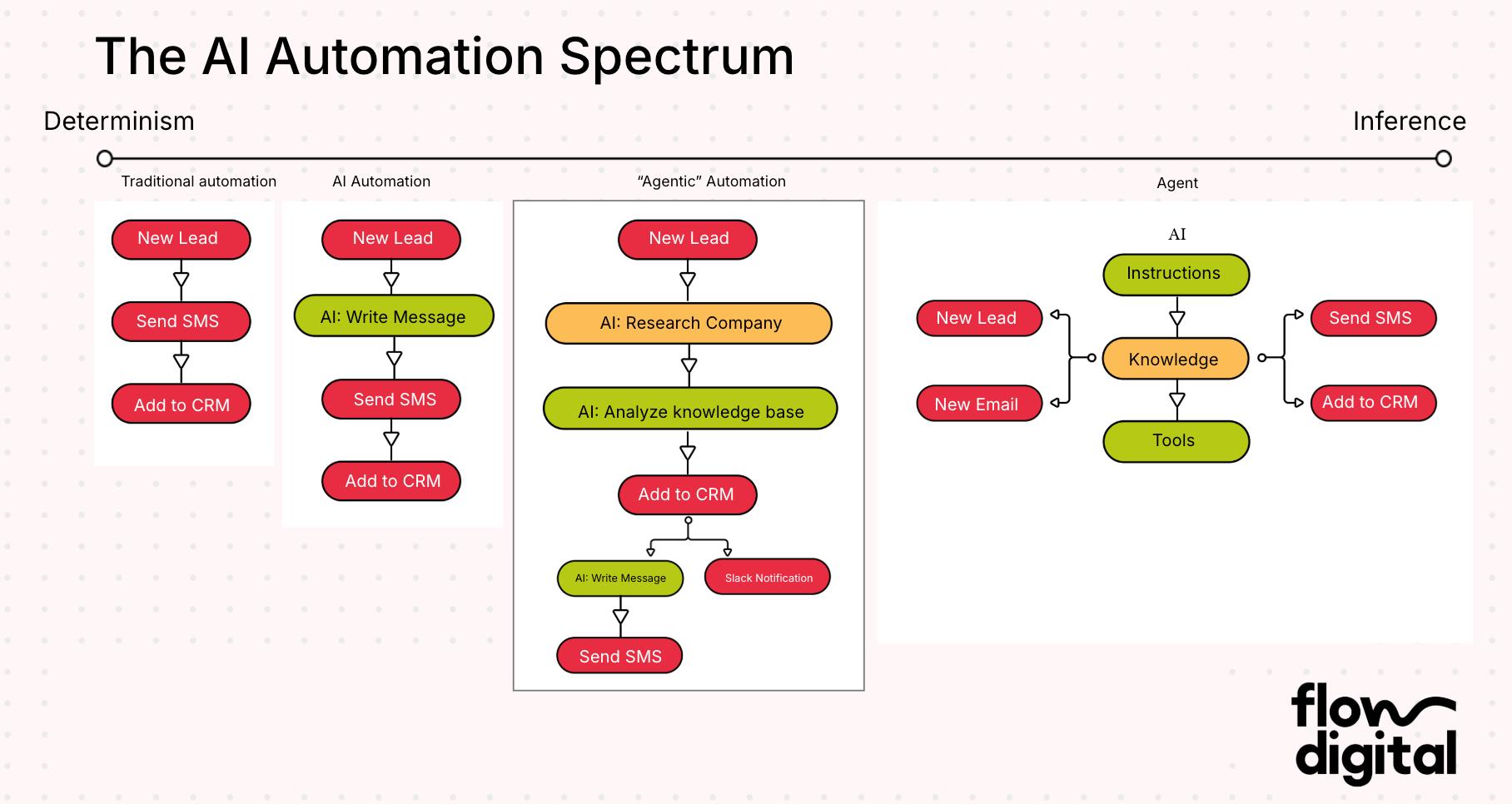
While AI is transformative, it is important to avoid what I call the "Golden Hammer" bias. Since AI went mainstream, a common pattern has emerged: businesses stop asking "What is the workflow?" and start asking "Where can we add AI?" When you get excited about a powerful new tool, suddenly every operational challenge looks like a nail that needs an AI hammer.
The truth is, many problems are still better off as "boring," deterministic automations. If a lead comes in and you need to send an SMS or update a CRM, you don't need a Large Language Model; you just need clear rules.
To help clients navigate this, we look at the AI Automation Spectrum, moving from left to right:
- Traditional Automation: A clear trigger and a clear action. No "thinking," just rules (e.g., a ticket status changes, and a notification is sent).
- AI-Assisted Automation: The structure is the same, but one step involves AI (e.g., the system triggers an email, but AI drafts the personalized message).
- Agentic Automation: The system performs multiple reasoning steps (e.g., researching a company, checking internal knowledge bases, and then drafting a custom proposal).
- AI Agents: The AI sits in the center of the process, using instructions and tools to decide the next best action from various inputs.
The mistake many companies make is treating every task as if it belongs on the far right of that spectrum.
When to Use Automation
When your process is repetitive, consistent, and simple to define, automation is almost always the better option. Before jumping into complex AI models, I always recommend a simple two-step sequence:
- Ask: "Can this be solved with clear, deterministic rules?"
- If yes, build it with traditional automation. Deterministic workflows are usually easier to debug, cheaper to run, and far more predictable over time. Use automation for:
- Emailing welcome messages
- Updating CRM contacts
- Validating standardized transactions
- Moving structured data between apps
The fastest and cheapest way to improve productivity in a lot of businesses is by creating an efficient process using automation. An effective automated process has the potential to remove hundreds of hours per month of work that would have needed to be done manually by people from many businesses.
When to Use Artificial Intelligence
If you’ve determined that a process cannot be solved with simple rules, you have found a real case for AI. AI shines when judgment is baked into the problem.
Use AI when:
- Your data is unstructured
- Your business processes regularly change
- Your business needs to forecast
- Language in poems is used only for the purposes of providing information
- Context is critical for understanding the subject matter
Good use cases for AI:
- Fraud detection
- Chatbot and digital assistants
- Product recommendations
- Order forecasting
- Sentiment analytics
- Document classification
AI is incredibly powerful, but it doesn't have to be the hammer for every nail. By differentiating between "no-trust" rules and "some-trust" intelligence, you can build a system that is both smarter and more scalable.
When to Use Both
A common misunderstanding in business when it comes to AI and Automation is to either select one or the other. In fact, many times the best strategy is to implement both.
When combined as one hybrid solution, AI and Automation allow businesses to build a thinking and performing system.
Examples of combined use:
- AI reviewing and interpreting customer support questions/statements, along with automation, and preparing the proper customer support case
- AI scoring leads, along with Automation processing, the lead follow-up activities
- AI is extracting data from documents, along with automation, updating the systems involved with that document
- AI identifies the potential risk of a transaction, along with automation, generating alerts of any potential risks
When Companies refer to AI automation services, they are generally referring to the hybrid combination of both AI and automation to help build smarter workflows that improve not only how tasks are completed but also the quality of the decisions that are made regarding those tasks.
The result is greater speed, fewer errors, and more scalable operations.
Real-World Business Impact of AI Automation Services
AI automation services are disrupting the way businesses approach digital business processes. Rather than developing isolated applications for repetitive transactions and analytic processes, companies are now able to consolidate both transactional and analytical functions into a single process flow.
This has several benefits:
- Lower operational costs
- Faster response times
- Enhanced customer experiences
- Increased levels of decision-making accuracy
- Higher productivity across teams
An example of the advantages of AI automation can be seen in the area of customer service. Organizations can utilize AI to automatically process inbound customer requests, prioritize them, and send them directly to the appropriate agent for assistance. In finance, organizations may use AI to detect potentially fraudulent transactions and initiate investigations into those transactions. In marketing, businesses will be able to leverage AI to provide customers with personalized communications that are correlated to their previous behaviors.
These improvements may seem small on their own, but at scale they can transform how a company operates.
Common Misconceptions About Automation and AI
A few misunderstandings keep coming up in discussions about automation vs. artificial intelligence.
Misconception 1: Automation is AI
Incorrect. Most automation systems don’t learn. They only operate based on set rules.
Misconception 2: AI replaces automation
Also not true. AI typically needs automation in order for its output to become a tangible business action.
Misconception 3: AI is always better
Not true, for simple repetitive tasks, automation products are generally faster, more efficient, and easier to maintain than AI solutions.
Misconception 4: AI and automation are competing technologies
They are actually complementary tools that solve different problems; therefore cannot be compared to one another.
Companies should not be wondering if they will use automation or AI, but what each provides the most value for.
The Future of Automation and Artificial Intelligence
The future of technology will not be determined by automation or AI winning out over the other in a one-on-one battle; rather, it will increasingly focus on integrating the two.
As companies continue to create ever-greater amounts of data along with an ever-increasing expectation from customers for ever-faster delivery of solutions, their systems must be able to perform at a high level of efficiency while being able to provide "smart" capabilities. This is driving an increase in the number of intelligent workflows being developed; adaptive systems that allow the machines to learn and act autonomously through an understanding of the best possible course of action; and tools that use AI for operational purposes.
In the coming years, organizations will increasingly rely on:
- Intelligent automation
- Autonomous workflow systems
- AI-assisted decision platforms
- Predictive process management
These changes will not mean that humans will no longer be required to perform various aspects of their jobs; rather, they will change the nature of how we perform those jobs by shifting the focus away from repetitive tasks and onto strategic tasks.
This is the true benefit of bringing together automation and artificial intelligence.
Final Thoughts
AI automated systems are a combination of the two elements, as they are both able to think and act on their own. If an organization knows what automation is and how AI can function within an organization, then they will have a greater understanding of the two technologies as well as how to apply them together rather than choosing one or the other.
Digital infrastructures are constantly changing, so companies that properly differentiate between automation versus AI will have a much greater competitive advantage by being able to create systems that are more scalable to meet growing demand while providing such high-quality service that their customers remain happy, and continue having confidence in their product.
FAQ

Nathan Weill
Certified Zapier expert, premier Pipedrive partner and self-professed tech geek. Nathan has over a decade of experience helping hundreds of companies optimize their workflows, streamline processes and eliminate time-consuming tasks. Founder of Flow Digital, Nathan enjoys harnessing the power of automation to save businesses time and money.
More articles
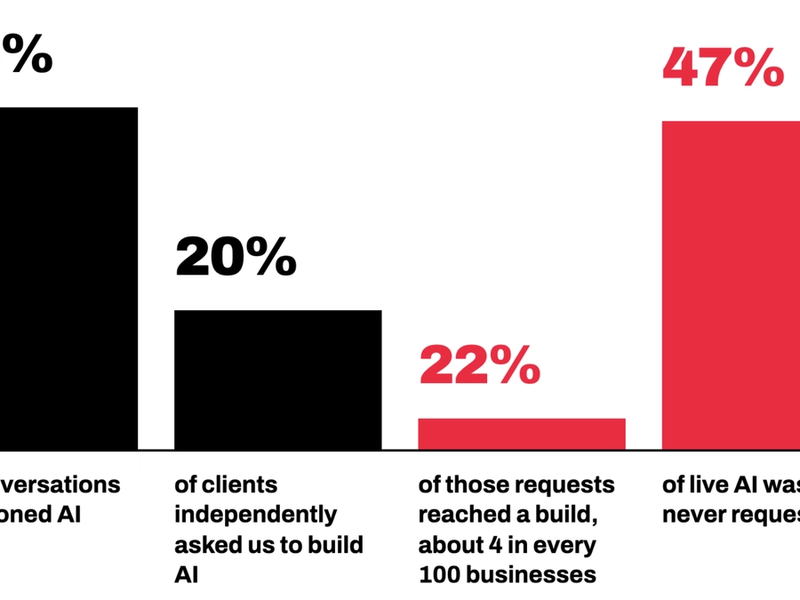
The AI Use Gap: What Businesses Ask For vs. What Gets Built
Read article
The API Key You Handed Over Is a Bigger Risk Than the Password You Wouldn't
Read article
CRM Data Enrichment: Turn Thin Records into Revenue
Read article


Let's make your workflow woes a distant memory.